Adjustable BDC Turrets | Range. Dial. Shoot.

Range. Dial. Shoot.
3 simple words: a promise made to hunters and target shooters the world round in reference to BDC dials.
But are they really that simple? Today we are going to take a deep dive into BDC (bullet-drop-compensating) dials and cover what they do well and where they miss the mark.
Then we will tell you about ZeroTech's new Adjustable BDC Turrets and how they take the best of both worlds and turn it into a revolutionary new system.

Jump to a Section
What Is a BDC Turret?
A BDC turret is a relatively simple concept, one that is built around some complex mathematical equations. When a bullet exits the barrel of a rifle, the speed, weight, and ballistic coefficient (BC) all interact with external environmental factors such as air density, humidity, elevation, temperature, etc., to affect how a projectile travels through the air and the speed at which it drops.
Due to the wonders of ballistics apps and calculators, we can plug in what we know about our ammunition: velocity, BC, and bullet weight – as well as our environmental factors: humidity, elevation, temperature, and voila! Out pops what is known as a drop chart or a DOPE card.
DOPE is a slang term derived from military snipers; it stands for Data On Previous Engagements. DOPE was used long before we had little supercomputers in our pockets at all times and DOPE cards were built on years of experience and thousands of rounds fired in real-life scenarios.
These cards or charts show distances in yards or meters and the corresponding drop, either in inches, MOA, or MILs, which a shooter then dials their turrets accordingly; i.e., if we take our data and it shows that at 500 yards our bullet will drop 20 inches, or 4 MOA, we can adjust our elevation turret up 4 MOA to ensure a hit on target.
A BDC turret simplifies this equation one step further. Instead of requiring the shooter to learn MILs or MOA and how they correspond at distance, a BDC turret is a laser-engraved turret that replaces your MIL or MOA markings with yards or meters. For example, if you range your target and it is at 350 yards, you simply dial to the 3.5 on your BDC turret.

This system is great for simplifying shooting for new shooters, women, and children getting into shooting, or anyone who just doesn't want to switch between an app/drop chart and just range their animal or target and shoot. Oftentimes your turret will retain its .25 MOA or .1 MIL increments, but you lose the individual markings on the turrets themselves which now only reflect distances.
Many optics makers offer this service where you provide them with all the data around your specific cartridge and shooting environment; they laser-engrave a custom turret for you and ship it right to your door with the promise of range, dial, shoot.
Where BDC Dials Miss the Mark
Now, if this sounds like the greatest system in the world, you might be wondering why everyone isn't running one? Well, like any system that simplifies things, there are concessions that must be made. In the author's humble opinion, that drawback comes with distance shooting in varying conditions.
You see, to get the mathematical equation that maps out our bullet's drop, all the conditions must be constant. Obviously, this is not the case in real life. You are not shooting in a temperature-controlled indoor environment when you are out hunting or shooting long range.
Swings in temperature, humidity, and altitude are all going to affect how your bullet performs. Take, for example, this 7 PRC shooting out of a Christensen Ridgeline. Note: nothing is changed in this equation except for altitude.


As you can see by changing the elevation, my data changes by nearly a quarter MIL. That may seem minuscule, but this is enough that if I am shooting at something 800 yards away, I will miss by 6.34 inches.
This is also a very realistic scenario. Where the author lives in Wyoming is just around 4,000 ft above sea level, but he will often find himself hunting anywhere from 8,000–10,000 ft, meaning you will either need 2 separate dials for practicing and hunting or remember the differences and apply them.
This not only negates the whole idea of dial to your range, but it introduces factors that could make you slip up when your moment comes to take the elk of a lifetime. Not an ideal plan.
Now this is just one variable; take into account all the other environmentals and you can really start to see even bigger shifts. Now most people are aware of this and combat it by giving their load data and averages of the environmental factors of the areas they are hunting and shooting.
And to be completely honest, this won't matter to most shooters if those shots are staying under 500 yards and if they hunt in relatively temp-stable environments without significant altitude changes. But for those that hunt the West and are out for days at a time in shifting weather and altitudes and may need to take a long cross-canyon shot, you want to make sure all of your hard work doesn't end in the disappointment of a miss, or worse, a wounded animal.
Environmental Factors Aren't Everything
Beyond the considerations that are out of your control, let's take a look at something that is within your power to control (mostly), ammunition. If you shoot enough, you know that due to the voodoo of barrels you are going to find some combination of ammo that your particular gun likes to shoot better than others. You are then going to purchase a large quantity of this ammo, assuring it is from the same lot.
A lot is a run of anything from factory ammo to powders, primers, brass, and bullets that are produced in the same factory run and have similar tolerances. Just because you bought a box of Hornady Match for your 7 PRC doesn't mean the same ammo, of the same weight, in the same labeled box is going to shoot out of your gun the same if you buy the boxes from the store 6 months apart.

Odds are the store has restocked a new lot and something about the components has shifted, and you will need to re-zero your gun to the new box and hope it shoots like the last lot did. Anyone with a lot of trigger time will tell you if you find a lot of ammo that your barrel likes, buy a lot. This extends to handloading components as well.
So, say you get yourself a nice, fancy, custom, laser-engraved dial and one day your bullet well runs dry. Unfortunately for you, even if you go buy the exact same bullet weight and box, odds are the ballistics are going to be different. I have seen as much as 150 fps swings between two different lots of factory ammo, and this means your dial is no longer trued to your ammo.
So now, what do you do?
Do you calculate and remember the distance as mentioned before? Kind of defeats the purpose.
Do you order another dial? Ranging anywhere from $50–$100 before shipping isn't ideal if you know this is going to keep happening.
Do you go back to just using a traditional dial and utilize MILs or MOA? For many, that has been tried and true.
The ZeroTech Adjustable BDC
But what if a better option entered the conversation?
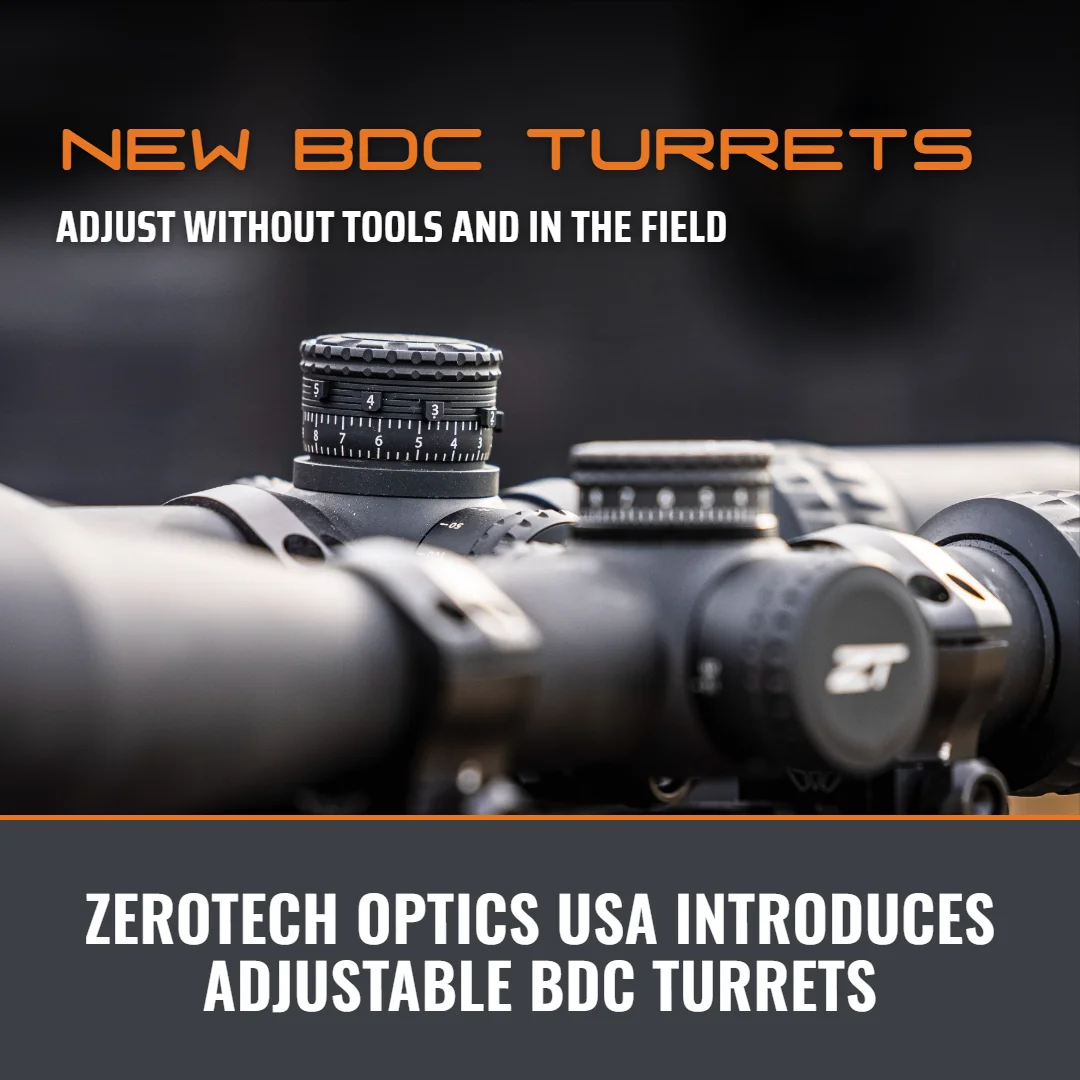
The ZeroTech Adjustable BDC may just be the hero we have been waiting for: simplified shooting without sacrificing your MIL/MOA markings, all while maintaining toolless field adjustability and versatility.

These new, exciting BDC turrets do something no others have done before. They give you Adjustable Impact Markers (AIM) that are toolless and fully customizable. These indicator markers sit above your traditional MIL or MOA markings on your turret and are easily set by twisting an unlock knob on the top and moving the corresponding number.
Each ZeroTech Adjustable BDC Turret has 5 different markers that can be used as quick references just like a standard BDC turret. Zero your rifle at 100 yards and set marker 1 to 200 yards, marker 2 to 300 yards and so on and so forth.
Best of all, while you have these quick reference markers standing out, you still have standard .25 MOA or .1 MIL references underneath for any adjustments or custom dialing that need to be done! If your environmentals change on the day and you need to go back to using standard measurements instead of your presets, they are right there for you, unlike a laser-engraved turret which will only show yardage.
The best part? If your load ever changes or the environmental factors change, you can adjust your AIMs right then and there with no tools! Simply unlock the marker you wish to change, spin it to match your correction, verify, and lock it.
Use Cases
- A reloader has a tried and tested handload that he has made a custom dial for. Eventually, he is going to run out of a lot of one component: brass, primers, powder, or bullets. Instead of needing to buy a whole new turret, the reloader can simply take his new load out, adjust his impact markers, and he’s good to go.
- A hunter or competition shooter buys a case of ammo that his rifle shot incredibly well with; he then buys a laser dial. One day, he runs out of that and he buys the same exact ammo type from the same exact manufacturer, but it’s not a different lot and his drops have changed. Laser-engraved = out of luck. Adjustable BDC Turret = some quick math and 5 seconds of work.
- A competition shooter who is shooting known-distance stages. If a shooter knows his distances before the clock starts, he can set his impact markers for fast adjustments under pressure when the timer starts. He can then move on to the next stage, consult his DOPE, and adjust them on the fly for his next round of targets.
- A hunter sitting and glassing a hillside. If there are several clearings where you expect an elk or a deer to pop out, you can pre-range them and set your dials with data taken from that moment in the event you need to take a quick shot on an animal as it comes out into a clearing at last light.
How They Work
The ZeroTech Adjustable BDC dials are incredibly easy to use and manipulate.
Simply move the top dial so the white dot corresponds with the number indicator you want to move; i.e., choose 1 to move the number 1 on the turret. While you are on a particular number, all the others are locked, so there is no chance of nudging them. Go through this process for 1 to 5 and then set the top dial to the “locked” setting available on either side.


Turrets shipped from the factory will already align perfectly with the zero markings on the scope itself. However, if you buy one aftermarket to use on an existing Thrive or Thrive HD scope, you may need to spin the turret to match the laser lines perfectly.
This is accomplished by removing the top screw via a flathead and then loosening the 3 grub screws underneath that to freely spin the turret. After you are happy with the alignment, you can lock those back down and you’re good to go.
Traditional MIL/MOA Markings
Perhaps the feature that stands out the most on these turrets is that you retain your traditional MIL/MOA markings underneath your reference markers. On a traditional BDC dial that is laser-engraved, the turret still functions in .25 MOA or .1 MIL increments, but if your yardage markers are off for any of the reasons previously listed, a shooter will have to count each click instead of visually dialing to the correct drop.
The ZeroTech Adjustable BDC turrets are an exciting new innovation and will be right at home on your new ZeroTech scope or as an upgrade to legacy Thrive and Thrive HD scopes. Customers should be sure to visit our website or scan the QR code on the box to ensure their existing Thrive Classic or Thrive HD Classic models are compatible with the Adjustable BDC turrets before purchasing. You can find them online or at any of their nationwide retailers.